BMAD Method – In-Depth Overview, Evaluation, and Comparison
What Is the BMAD Method?
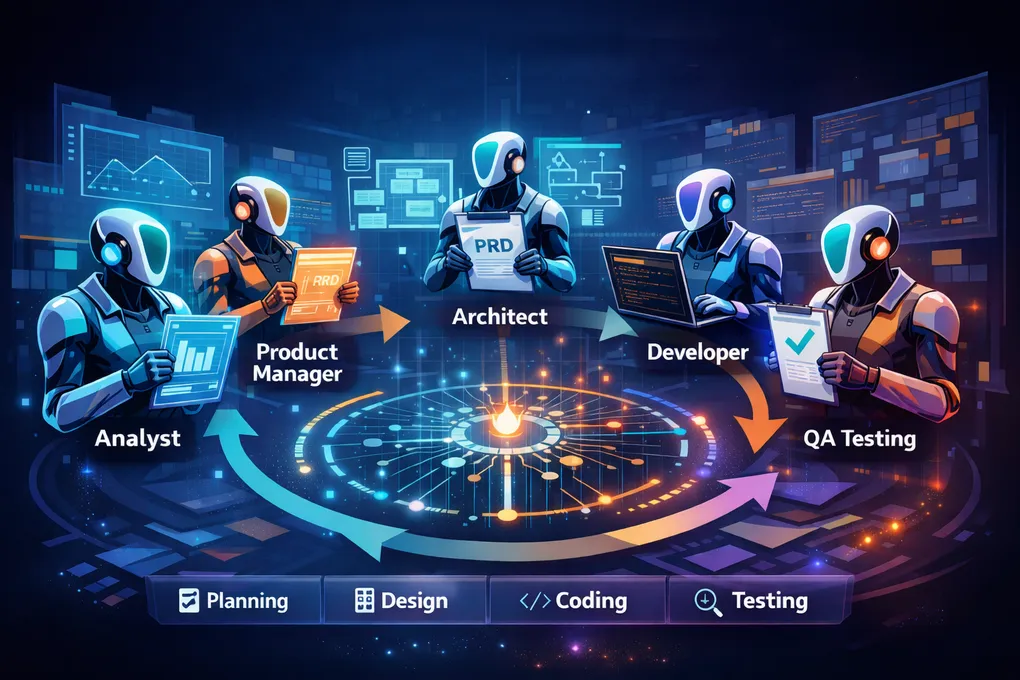
The BMAD Method stands for the Breakthrough Method for Agile AI-Driven Development. It is an AI-native software development framework that simulates an entire agile team using multiple specialized AI agents. Rather than treating an AI like a simple autocomplete tool, BMAD segments the development process into roles – e.g., Analyst, Product Manager, Architect, Developer, QA, etc. – with dedicated agents fulfilling each role [1]. These agents collaborate through structured workflows to produce all the artifacts of a traditional software project: from market research and requirements (PRDs) to architecture designs, code implementation, and testing [1]. In essence, BMAD transforms an AI coding assistant into an “AI development team” orchestrated by the user, following agile best practices [1].
BMAD’s core promise is to bring the rigor of agile methodology into AI-assisted coding. Just as a real software team wouldn’t start coding without precise requirements and design, BMAD enforces upfront planning and clear hand-offs between roles [1]. For example, an Analyst agent conducts market and competitive research to shape the project’s business case [1]. A Product Manager agent then converts those objectives into a comprehensive Product Requirements Document (PRD) with detailed functional/non-functional requirements, epics, and user stories [1]. Next, an Architect agent produces system design specs, tech stack choices, and data flow diagrams based on the PRD [1]. This upfront “Agentic Planning” phase yields a thorough blueprint before any code is written [1]. By having multiple AI agents contribute their domain expertise (business analysis, requirements writing, design), BMAD creates a cumulative understanding of the project that rivals an experienced human team’s collective intelligence [1].
Theoretical Underpinnings and Foundation
BMAD’s approach is grounded in established software engineering principles, particularly agile methodologies, but reimagined for an AI-centric context [1]. In traditional agile teams, roles such as product owner, Scrum Master, developer, and QA specialist work in concert. BMAD takes the “AI team” metaphor literally, assigning each role to AI agents and structuring their interactions through an agile-like workflow [5]. The underlying theory is that disciplined role specialization and workflow orchestration can overcome the chaos of unstructured AI coding. Early experiments with “vibe coding” (simply throwing prompts at an AI with no process) often yielded brittle or inconsistent results for anything beyond small scripts [1]. BMAD instead employs a context-rich, multi-agent process, ensuring that each development component is handled with a complete understanding of the project’s goals and constraints [3, 5]. This addresses the key theoretical challenge in AI code generation: context loss. As projects grow more complex, a single AI can “forget” earlier instructions or reasoning (a phenomenon known as “context collapse”) [1]. BMAD’s solution is an engineered flow in which artifacts produced at each phase carry context forward to the next phase, serving as persistent memory for the agents [4].
Academically, BMAD aligns with emerging research in agent-based software engineering. A 2025 arXiv paper on Agentic Software Engineering cites BMAD as a prime example of structuring AI agents into an agile team to tackle complex projects [5]. The framework’s strengths – explicit role specialization, task sharding (breaking work into smaller tasks), and parallel execution by multiple agents – align well with the research vision of scalable AI-driven development [5]. In fact, BMAD’s multi-agent orchestration of planning, coding, and validation is seen as a stepping stone toward future Software Engineering 3.0 paradigms [5]. Its foundation is not a radical new theory but rather the fusion of traditional agile disciplines with AI capabilities [1]. By enforcing structured roles and “agent guardrails,” BMAD acknowledges the “human-AI partnership” approach advocated by researchers, in which human insight provides strategic guidance and ethical oversight. In contrast, AI provides speed and scale [5]. In short, BMAD’s theoretical underpinning is that adding structure and explicit knowledge to the AI development process yields more reliable outcomes than naive free-form coding, especially for novel or large-scale tasks where purely data-driven AI can falter [5].
How the BMAD Method Works (Workflow Breakdown)
BMAD projects are typically organized into four phases, with more than 30 modular workflows guiding the process [2]. Here’s how it works in practice, step by step:
- Agentic Planning (Phase 1: Analysis & Requirements): The project starts with planning agents that generate all necessary documentation and plans. The Analyst agent performs market research and feasibility analysis, ensuring the idea makes business sense [1]. The Product Manager (PM) agent then produces a detailed PRD that captures functional and non-functional requirements, user stories, acceptance criteria, and success metrics [1]. Together, they transform a vague idea into a concrete project plan. This is complemented by an Architect agent who drafts the technical architecture – system components, data models, interface designs, security considerations, etc., based on the PRD [1]. By the end of this phase, you have what a real team might take weeks to create: a validated business case, complete requirements, and architecture docs. Notably, BMAD’s planning agents cross-verify one another’s outputs, thereby minimizing missed requirements and inconsistencies. This upfront investment creates a “single source of truth” for the project that all subsequent steps will reference [1].
- Context-Engineered Development (Phase 2: Breakdown & Design): Next, BMAD addresses context management through what it calls “epic sharding,” or document sharding [1]. The large PRD and design specifications from planning are decomposed by a Scrum Master agent into a set of focused story files or task briefs [1]. Each story file is a self-contained unit representing a user story or feature and includes all relevant context: the specific requirement, design guidance, and the rationale behind it (embedded reasoning), as well as test criteria for QA [1]. This means when the Developer agent works on a story, it sees the “what” and “why” entirely in that story file, avoiding the need to re-prompt for huge context every time. BMAD encodes context into artifacts rather than relying on an LLM’s memory. The Developer agent then implements code for each story sequentially, leveraging the rich context to maintain consistency with the overall architecture [1]. Crucially, after each story’s code is written, a QA agent validates it against the original requirements and acceptance criteria for that story [3]. This story-by-story cycle ensures that every piece of code is tested and aligned with the spec before moving on [1]. In other words, working software (with passing tests) is delivered at the end of each story, echoing agile’s incremental delivery but at AI speed.
- Orchestration & Parallelism (Phase 3: Multi-Agent Coordination): The Orchestrator agent (or orchestration logic) oversees the entire process, managing dependencies and quality gates [1]. This is akin to a project manager or a CI/CD pipeline for the agents. The orchestrator ensures that, for example, the Architect agent doesn’t start design until the PM agent’s PRD is complete, and that the Developer agent only picks up a story once the Scrum Master and all prerequisites for the story file are satisfied [1]. It also checks the outputs of each agent. If an artifact (say, an architecture design) is incomplete or ambiguous, the orchestrator can route it back for refinement before passing it downstream [1]. Another key function is maintaining an “agentic memory”, a persistent project knowledge base that all agents can query [1]. This prevents the left-hand/right-hand problem, in which one agent might otherwise forget decisions made earlier by another. The orchestrator streamlines the multi-agent workflow, preventing bottlenecks and keeping all agents synchronized with the project’s evolving state [1].
- Implementation & Iteration (Phase 4: Coding, Testing, Deployment): With stories in hand, the Developer agent codes each feature, and the QA agent tests it as mentioned. BMAD encourages iterative development – after a set of stories (a sprint) is done, the results can be reviewed and the plan adjusted if needed (just as in agile scrum) [3]. The framework produces extensive artifacts during implementation: code with documentation, unit tests (often hundreds of tests, as some users report), and updated documentation. By project end, BMAD isn’t just spitting out code, but a complete project package – including generated user docs, technical docs, and compliance evidence [3]. Deployment can also be guided by agents (e.g., a DevOps or Deployment agent may be part of the workflow, although this is not always highlighted in basic BMAD descriptions). The outcome is production-ready software with an auditable trail from requirements to tested code [4].
This structured breakdown enables BMAD to be evaluated at each stage, in a manner analogous to a human process. You can assess the quality of the PRD and design (did the AI catch all requirements?), the clarity of story breakdown (are stories well-scoped with no ambiguities?), the code quality for each story (does it pass tests and code review?), and the integration of all parts at the end. Each phase’s output in BMAD is explicit and reviewable. E.g., you can inspect the generated PRD for completeness or the test results for each story, which provide clear evaluation points for the workflow’s effectiveness [3]. This contrasts with ad hoc AI coding, where evaluation is more difficult because there’s less structure to measure against.
Practical Applications and Impact on Productivity
In practice, the BMAD Method has shown substantial increases in productivity for specific projects. Enthusiasts report building non-trivial applications in hours using BMAD, whereas a traditional team could take weeks or months [4]. For example, one case study described how a non-developer used BMAD (with Anthropic’s Claude model as the AI engine) to build a SaaS web application in 4 hours, including a working codebase, documentation, and test suites [4]. The secret was treating the AI not as a single coder, but as an “AI development orchestra”. Each agent contributed its part in parallel or sequence, making the process highly efficient [4]. By front-loading the planning (which uses substantial AI “thinking” up front), BMAD ensures the coding phase proceeds smoothly with minimal backtracking. This often results in faster delivery and fewer integration issues, since potential problems are identified during the design or story phase [1].
Another practical benefit is consistency and quality of output. Because BMAD generates extensive documentation (architectural designs, rationale, etc.) and automated tests, it maintains project rigor. Users have noted that projects which would “fall apart” under unstructured AI coding stay on track with BMAD – the code remains maintainable and aligned with the design even as it scales [3]. One early adopter observed that BMAD produced “nearly 100 pages of documentation and ~350 unit tests” for the first epic of a large project, with all tests passing for each story [3]. This level of thoroughness is rarely achieved with plain-vibe coding or even by some human teams, and it leads to more robust, less brittle software [3]. The structured QA steps ensure that hallucinations or errors by one agent can be detected and corrected by another, thereby serving as a built-in safety net [3]. Indeed, one appeal of BMAD is that by having agents “check each other’s work,” it can reduce the incidence of unchecked AI errors or wild deviations from the plan [3].
BMAD’s creators also emphasize token efficiency and cost in real applications. Despite the method seeming heavyweight, its strategy can optimize AI usage by avoiding repetitive context prompts. Since the planning artifacts are created once and reused, developers aren’t constantly refeeding the AI with the same context in each prompt, which reduces token consumption over a long project [1]. In fact, BMAD v6 reportedly achieved “from token hell to 90% savings” in AI usage through more innovative context management and artifact-based knowledge caching [1]. However, it’s worth noting that running BMAD still requires a capable LLM and can consume substantial tokens for large projects – early users have cautioned that a subscription or high token limit is necessary for heavy use, citing hundreds of millions of tokens potentially used in complex builds [3]. Overall, in practical terms, BMAD incurs higher initial overhead (setting up agents and learning workflows) for greater long-term productivity and consistency in non-trivial software projects [4]. It is particularly attractive to startups or teams seeking to deliver products more quickly without compromising design documentation or quality standards [4].
Comparing BMAD to Other Development Methods
BMAD emerged alongside other AI-driven coding approaches, and each takes a different philosophy. Here’s how BMAD compares to a few notable methods:
Versus “Vibe Coding” (ad-hoc prompting): Vibe coding refers to the unstructured use of AI – you prompt an LLM on the fly to write code, in a creative, freeform way. This can be quick and engaging for small tasks, but it often breaks down on larger projects due to a lack of structure [3]. BMAD is essentially the opposite of vibe coding: it sacrifices a bit of that freeform spontaneity for disciplined, repeatable workflows. The benefit is that BMAD can handle complex, production-grade applications with far more reliability [3]. One observer put it this way: “Bmad is not really vibe coding, it’s spec coding” – meaning BMAD feels more like following a spec-driven plan than improvising. If vibe coding is jazz, BMAD is an orchestral score. As a result, BMAD can feel more rigid and has a learning curve (it “requires a significant upfront investment in learning the process” [6]), but it delivers consistent results, whereas pure vibe coding might produce brittle code or stall on large tasks [3].
Versus GitHub Spec Kit (spec-driven development): GitHub’s Spec Kit is a lightweight framework that provides structure through Markdown templates and commands (e.g.,/specify, /plan, /tasks) [6]. It’s more developer-centric: you still drive the process, but Spec Kit helps you formalize requirements and break tasks down with minimal overhead [6]. Compared to BMAD, Spec Kit is simpler and easier to adopt – it won’t overhaul your workflow, just augment it [6]. However, it’s also less comprehensive. Spec Kit doesn’t provide multiple agents or automated role outputs; you, as the developer, still fill in a lot of the gaps. It’s ideal for small-to-medium projects where you want some order without “overkill” [6]. BMAD, on the other hand, excels in large, complex projects that require comprehensive documentation, architectural diagrams, and strict role separation [6]. It will generate those artifacts for you, whereas with Spec Kit, you might write parts of them yourself. Think of Spec Kit as adding a “spec-first” discipline to AI coding (often described as spec-driven or even a “waterfall-ish” approach in agile clothing), whereas BMAD is a full agile simulation. Notably, they aren’t mutually exclusive – one could use Spec Kit’s templating within BMAD’s flows – but generally BMAD is the heavier, more all-encompassing framework [7].
Versus Claude Code (Direct): Claude Code refers to using Anthropic’s CLI or chat-based coding assistant directly, without additional frameworks. It treats the AI as a powerful pair programmer in a conversational loop [6]. The advantage of this approach is simplicity and flexibility: you can tackle anything from debugging a small function to iteratively building features just by chatting with Claude, guided by your own style [6]. There’s no overhead of learning a framework; you manually “drive” the AI. Many developers, such as Claude Code, prefer working with existing codebases (brownfield projects), where exploratory dialogue and on-demand analysis are proper [6]. The BMAD method, by contrast, imposes a fixed structure on the AI interactions – great for consistency, but you lose some of the spontaneity and direct control. It’s also model-agnostic (you can, in theory, use any LLM with BMAD), whereas Claude Code is obviously tied to Claude [6]. In summary, if you need an AI co-pilot for quick tasks or maintenance work, using Claude (or ChatGPT) directly might suffice. But if you need an “AI autopilot” for a whole project with many moving parts, BMAD provides the governance that direct prompting lacks. As one guide put it, Claude Code is the hands-on power tool, while BMAD is the whole assembly line for software development [6].
Versus Traditional Human Teams: It’s also insightful to compare BMAD with conventional development methods (e.g., Agile/Scrum teams or Waterfall). BMAD is essentially Agile augmented with AI; it follows similar phases (analysis, design, implementation, testing) and roles, but compresses them temporally by leveraging AI’s speed. In areas such as documentation, testing, and adherence to process, BMAD can be more consistent than human teams (since an AI won’t “skip writing tests” out of tedium, for instance) [3]. It inherently creates a detailed audit trail of why and what was built (every agent output is saved), aiding consistency and compliance [1]. However, human teams bring creativity, contextual understanding, and stakeholder communication in ways that AI cannot yet fully replicate. BMAD lacks accurate intuition or deep understanding beyond its training data – it excels at following patterns and checklists. Thus, BMAD might be seen as enforcing a highly structured, almost bureaucratic process (some critics liken spec-driven AI frameworks to a return to waterfall-like rigidity [7]). The counterpoint is that BMAD’s structure is what ensures quality at speed – something ad-hoc AI use couldn’t guarantee. In practice, some organizations might blend the two: a human team providing high-level guidance and oversight, with BMAD-driven automation handling the grunt work of drafting docs, writing boilerplate code, and running tests. This hybrid approach leverages BMAD for productivity and consistency, while humans handle creative design decisions and final validation.
Academic Background and Origins
The BMAD Method originated among practitioners in the AI development community rather than directly from academia. It gained traction through open-source releases and community blogs in 2025, rapidly accumulating thousands of GitHub stars [2]. Its rise coincided with the “AI agent” trend, where developers experimented with using multiple AI instances for different tasks. Academics have since taken note of BMAD and similar frameworks as case studies for new software engineering paradigms. In the literature, BMAD is discussed under the umbrella of Agentic Software Engineering (SASE), which seeks to formalize how AI agents can participate in the software lifecycle [5]. Researchers Hassan et al. (2025) describe BMAD as a “comprehensive framework that organizes AI agents into roles like Product Owner, Architect, Developer, and Tester”, highlighting its agentic planning phase and story-sharding practice [5]. They note that BMAD’s strengths in role specialization and parallelism align well with the needs of complex projects, and they compare it with their proposed frameworks (which add concepts such as persistent agent memory and mentorship-as-code on top of BMAD’s capabilities) [5].
In terms of academic lineage, BMAD’s concepts build on decades of research in software engineering, including requirements engineering, agile methods, and multi-agent systems. The idea of breaking down requirements into user stories and having separate processes for design, coding, and QA is straight out of Agile/Scrum literature – BMAD simply automates those with AI [1]. The notion of multiple cooperating AI agents has roots in multi-agent systems research and even the AI planning community. However, BMAD is among the first widely used frameworks to apply these ideas end-to-end in software development. Its “agentic planning” echoes academic work on AI-assisted requirements gathering, while the “context-engineered development” addresses known issues in AI context management (particularly in prompt engineering research). There’s also an apparent influence of the “spec-driven development” movement, sometimes humorously referred to as “the Waterfall strikes back” by skeptics [7]. Frameworks such as Kiro’s SpecKit, OpenSpec, and Tessl emerged around the same time, emphasizing the writing of formal specifications or test plans for AI systems to consume [8]. BMAD’s approach is more agile than a pure spec-first waterfall – it creates specs and executes them in iterative loops – but academically it sits in the space between classical SE processes and AI automation.
Notably, BMAD itself is evolving and may spawn research: for example, questions of how to provide better IDE support for agentic development (the arXiv paper proposes an Agent Command Environment to manage AI teammates) [5], or how to version control AI-generated artifacts. Early lessons from BMAD users – such as the importance of archiving each agent’s output and reasoning for traceability – are feeding into research on making AI development observable and reproducible like traditional coding [5]. In summary, BMAD’s academic background is a pioneering, industry-driven methodology that informs scholarly research on the integration of AI with established software engineering practices.
Software Productivity and Consistency Gains
A central selling point of BMAD is its impact on productivity and consistency in software projects. By automating the laborious aspects of planning and documentation, BMAD can significantly compress development timelines. Case studies (such as Steve Kaplan’s) demonstrate that a minimal SaaS product can be launched in hours by one person and an AI, a feat of speed that would be nearly impossible in traditional settings [4]. This suggests an order-of-magnitude productivity gain (claims of “10x faster than traditional dev teams” are associated with BMAD in such anecdotes [9]). Even if 10× is situational, it’s clear that BMAD lets a small team (or even a solo entrepreneur) achieve in days what might take a multi-person team weeks, by parallelizing work across AI agents and eliminating downtime. For instance, while a human developer might slow down to write tests or documentation, BMAD’s QA agent and documentation workflows handle these tasks in the background or offload them from the developer’s cognitive load [4]. The consistency comes from the fact that every piece of code is traced back to a story, every story back to a requirement – nothing is built “just because” or without context. This traceability inherently improves consistency and reduces the risk of feature creep or architecture drift [1].
BMAD also enforces best practices (sometimes referred to as “AI guardrails”) to maintain high quality. For example, before implementation, an Implementation Readiness workflow can ensure the design is sound; after implementation, Test Design and Code Review workflows (often powered by separate agents or prompts) verify correctness [4]. Such rigor leads to more stable code and fewer regressions. In enterprise contexts, this can translate to easier compliance and onboarding. BMAD’s artifact trail effectively creates a “continuous compliance ledger,” in which every decision and requirement is automatically documented [1]. Companies that comply with standards such as SOC 2 or HIPAA could benefit, as BMAD transforms what used to be weeks of retroactive documentation into a byproduct of development [1]. Consistency is also evident in architectural integrity: because the Architect agent’s decisions (e.g., design patterns, security measures) are recorded and continuously referenced, the code is less likely to deviate into an anti-pattern that violates the original design [1]. In sum, BMAD’s structure provides predictability – in timelines, in code quality, and in documentation – which are all facets of software consistency.
That said, there is a trade-off: BMAD’s disciplined approach can feel slower at the very start (due to upfront planning) and may be overkill for simple tasks. If you just need a quick script or prototype, the overhead of writing a PRD via an AI agent might outweigh the benefits. But as projects scale, users find that the initial investment pays off by preventing costly rework and confusion later on [3]. In traditional terms, it’s like spending more time in design to save time in coding/debugging – a known strategy in software engineering. BMAD simply applies AI to make that strategy viable even in fast-paced dev cycles. The result is a more consistent output (with every feature documented and tested) without sacrificing the development speed enabled by AI.
Adaptability to Different Workflows (Game Development and Beyond)
One impressive aspect of the BMAD Method is its flexibility to capture domain-specific developer workflows. The core framework was initially tuned for typical software/web development, but it has since introduced Expansion Packs that plug in specialized agents and processes for other industries [10]. For example, BMAD includes a Game Development module (BMGD) that supports the game industry’s workflow [11]. This expansion adds agents like a Game Designer, Level Designer, Narrative Designer, and Art Director – roles critical in game creation that have no equivalent in standard app development [10]. It also provides domain-specific workflows (e.g., templates for a platformer game versus an RPG, including physics engines and quest design) [10]. In practice, this means that BMAD can guide an AI not only to write code for a game but also to generate game design documents, storylines, level layouts, and art style guides, mirroring how a whole game studio team would operate [10]. Early demonstrations with the Godot engine have shown that BMAD adapts to the creative and iterative nature of game development, effectively functioning as “a collaborative design studio in a box.” [10]. This suggests that BMAD’s structured approach is not limited to enterprise apps – it can capture any workflow as long as you can define the roles and artifacts for that domain.
Beyond games, the BMAD expansion pack system has been envisioned for domains such as healthcare, finance, creative writing, and others [10]. For instance, a Healthcare Pack could introduce a Clinical Advisor agent and compliance workflows for medical software, ensuring that treatment protocols or privacy rules are embedded in the development process [10]. The key idea is a “universal AI orchestration platform” – BMAD keeps its core focused on general software engineering. Still, you can “plug in domain-specialized AI agents, workflows, and knowledge bases” as needed [10]. This modular design enables BMAD to capture the specific workflows of virtually any project or system without compromising its core benefits. You install or activate the domain pack only when needed; for example, a game development project would use the game agents, whereas an enterprise cloud project might use a DevOps pack with Cloud Architect and SRE agents [10]. Each pack provides field-specific templates and checklists [10], which are crucial for accurately capturing workflows with specialized steps (e.g., the art asset pipeline in games or compliance checks in healthcare).
In evaluating BMAD’s ability to model other workflows, it appears promising. The framework serves as a meta-framework: it outlines how to structure AI involvement, and content packs specify the specific tasks and expertise. The success in the game development domain (one of the more complex, interdisciplinary workflows in software) is strong proof of concept. It shows that, with the appropriate domain knowledge encoded, BMAD can handle highly creative and iterative processes, not just straightforward CRUD applications. One could imagine using BMAD for a specific project type – say, an embedded systems project – by training or configuring agents to handle hardware constraints and using workflows for simulation and firmware testing. As long as the process can be broken into roles and artifacts, BMAD can likely capture it. Moreover, the community-driven nature of expansion packs enables experts from various industries to contribute, thereby further extending BMAD’s reach [10]. In summary, BMAD is suitable for capturing diverse developer workflows: it has already done so in game development, and its architecture supports adaptation to other domains or specialized project types with relatively low effort. This flexibility underscores BMAD’s role not only as a coding tool but also as a general paradigm for orchestrating complex work with AI agents [10].
Conclusion
The BMAD Method represents a significant evolution in AI-assisted software engineering. In depth, it is a comprehensive, agent-driven workflow that brings the discipline of agile teams to the speed of AI development [1]. We broke down its phases – from agentic planning to context-engineered development – and saw how each can be evaluated much like traditional processes for completeness and quality. Compared with other methods, BMAD trades a steeper learning curve and upfront overhead for unmatched structure and reliability on complex projects, whereas lighter frameworks (such as Spec Kit or direct “vibe” coding) might be easier but less thorough [6]. Its academic grounding in established SE principles and recognition in research circles give it credibility beyond a fad [5]. Perhaps most importantly, BMAD has demonstrated improvements in productivity (rapid development) and consistency (maintaining quality and alignment) that address many challenges associated with AI use in development [4]. By capturing the essence of developer workflows – be it a web app or a video game – BMAD shows that AI can be harnessed not just to write code, but to orchestrate the entire software lifecycle in a repeatable, auditable way [10]. As the software industry moves toward AI-native practices, BMAD stands out as a blueprint for blending human-like project rigor with machine-driven efficiency, potentially heralding a new standard for building software faster and more effectively.
Sources: The information above was synthesized from the BMAD open-source documentation and code repository [2], first-hand user reports and comparisons in community forums [3], as well as a range of articles and essays by early adopters and experts (e.g. Vishal Mysore, Steve Kaplan, Pradeep Batchu) analyzing BMAD’s features and comparing it to alternatives [4, 6, 10]. The academic perspective was drawn from a 2025 arXiv research paper that explicitly discusses BMAD in the context of agentic software engineering [5]. These sources collectively provide a thorough view of what BMAD is, how it works, and its place in the evolving landscape of AI-driven development.
References
[1] Holt-Nguyen, C. (n.d.). Mastering the BMAD method: A revolutionary approach to agile AI-driven development for modern software teams. Medium. https://medium.com/@courtlinholt/mastering-the-bmad-method-a-revolutionary-approach-to-agile-ai-driven-development-for-modern-e7be588b8d94
[2] bmad-code-org. (n.d.). BMAD-METHOD: Breakthrough method for agile AI driven development [Computer software]. GitHub. https://github.com/bmad-code-org/BMAD-METHOD
[3] Anyone here seriously using the BMAD Method for vibe coding? Worth the hype or overkill? (n.d.). Reddit. https://www.reddit.com/r/vibecoding/comments/1m3b02m/anyone\_here\_seriously\_using\_the\_bmad\_method\_for/
[4] Kaplan, S. (n.d.). The BMAD method: How I build AI apps 10x faster than traditional dev teams. Medium. https://stevekaplanai.medium.com/the-bmad-method-how-i-build-ai-apps-10x-faster-than-traditional-dev-teams-23fddf0ff56e
[5] Hassan, M., et al. (2025). Agentic software engineering: Foundational pillars and a research roadmap. arXiv. https://arxiv.org/html/2509.06216v1
[6] Batchu, P. (n.d.). Choosing your AI coding framework: Spec Kit vs. BMAD vs. Claude Code. Medium. https://pradeepbatchu.medium.com/choosing-your-ai-coding-framework-spec-kit-vs-bmad-vs-claude-code-1a8fa261a751
[7] Marmelab. (2025, November 12). Spec-driven development: The waterfall strikes back. https://marmelab.com/blog/2025/11/12/spec-driven-development-waterfall-strikes-back.html
[8] Spec Kit: How to build production-ready apps with AI agents [Video]. (n.d.). YouTube. https://www.youtube.com/watch?v=8jtIXRyGMQU
[9] Kaplan, S. [@HiSteveKaplan]. (n.d.). 6/ Someone could literally steal my idea right… [Post]. X. https://x.com/HiSteveKaplan/status/1957629050236858765
[10] Mysore, V. (n.d.). BMAD-METHOD universal agent framework: Expansion packs that transform AI into any domain. Medium. https://medium.com/@visrow/bmad-method-universal-agent-framework-expansion-packs-that-transform-ai-into-any-domain-0a640a26bb81
[11] bmad-code-org. (n.d.). BMAD-METHOD: BMGD (BMAD game dev) module documentation. GitHub. https://github.com/bmad-code-org/BMAD-METHOD/blob/main/docs/modules/bmgd-bmad-game-dev/index.md